

My friend thought he had hacked the LinkedIn algorithm. He wrote about the Lazada retrenchment, and his post impressions spiked. We both assumed that the event had carried the post. So, when GovTech announced retrenchments, he tried the same thing again. This time, nothing happened.
That is the problem with trying to crack the LinkedIn algorithm. We extrapolate one good result into a rule, but it doesn’t hold up to the next post.
I don’t proclaim to know the LinkedIn algorithm, but I can show you what happened on my account, including the posts that failed.
How does the LinkedIn algorithm work in 2026?
Yes, but it’s more nuanced than what some LinkedIn influencers claims.
In March 2026, LinkedIn said it was rolling out a feed-ranking system. Instead of just pushing posts to your first-degree connections, they would push posts to people outside of your immediate network, provided that they are interested in that area. This is great because it helps people with great content but small reach gets discovered. [Read LinkedIn’s March 2026 feed explanation for details, but be warned, it’s dense!]
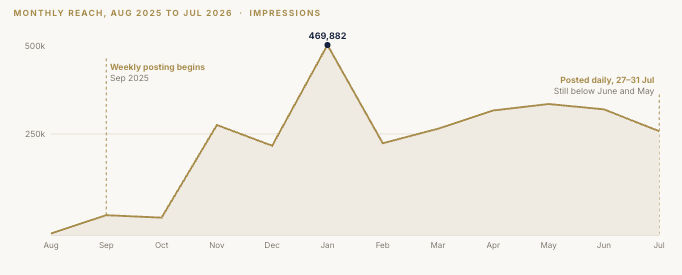
Coincidentally, my impressions also started increasing around the same time, so I could have been a lucky beneficiary of this new algorithm. (My impression dipped in July because I decided to shift away from writing about personal problems like job seeking to talking about institutional problems such as branding and communications.)
How to get more likes and comments?
That’s a trick question. I don’t think these vanity metrics are a useful measure of your growth potential.
My friend once told me that his posts with the most likes are the ones that are the most superficial. These were posts of him that took him five minutes to write, and featured him collecting an award, announcing a promotion, or speaking at an event. He sighs and said that the book review that he took an hour to write, something he thinks his whole industry should read, drew just thirty likes.
So why am I asking you to write thoughtful posts if shallow posts “perform better”? It only seem that way because we are looking at the wrong metrics.
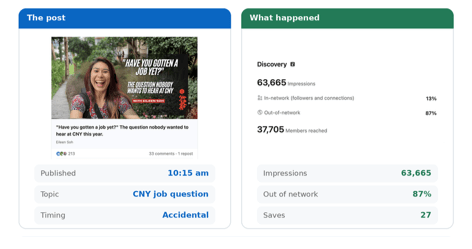
Take this post I wrote a year ago. (See diagram below, left column.) It’s the typical “I’m honoured to have spoken at this conference” post. It raked up 95 reactions, as much as another long-form article I wrote about a friend who built a multi-income, multi-portfolio career. But the latter post raked up 33 saves too, meaning my readers found it useful enough to bookmark it so they can return to it again. The second post has greater longevity as LinkedIn is more likely to keep promoting it, helping more people know about me.
I know that for a fact LinkedIn posts can keep circulating. Just last week, someone connected with me because of a post I had written nine months earlier. LinkedIn was still circulating it.
That’s what a good LinkedIn post should do, bring you into rooms that you otherwise wouldn’t be able to enter, even long after you’ve forgotten about the post.

LinkedIn post vs article vs carousel vs video: which works best?
I prefer writing articles because they are the only format that can accomodate proper stories.
But I’ve heard people asking if articles are more prohibitive to readers because you need that one extra click for people to go into the article as compared to posts. Not many people know that you can click on the picture to read the article, so very often they’ll just read the post and wonder why I stopped my stories halfway.
But I heard that carousels perform well, so I ran a small experiment
I converted some of my older articles into carousels. My results was surprising. Both my carousels performed poorly, getting half as many reactions as the original article. But there are confounding factors, the main one is, I have curated an audience that is used to long-form arguments. Someone with a different audience may see the opposite result.


Finally, there are claims that LinkedIn videos do particularly well.
LinkedIn push them out aggressively in a bid to compete with TikTok and Instagram. Well, mine performed so poorly (I think it was 6 likes) that I took it down after half a day.
What should you post on LinkedIn?
Across my best-performing posts, I keep seeing the same three ingredients. They are posts that makes readers go “that’s interesting”, “that’s useful” and “that’s me”.
1. ‘That is interesting’
The opening contains a contradiction, an irony or an unfinished question.
For example: ‘You just sabotaged your best-performing individual contributor.’ Promoting someone is supposed to reward them. How could it backfire? That gap pulls the reader into the story.
2. ‘That is useful’
The post helps the reader solve a perennial problem with a simple solution.
In ‘Why your top talent quits without warning, and the $10 fix,’ readers find out that a small Starbucks card can surface a problem before a good employee resigns.
3. ‘That is me’
The reader recognises their own frustration, ambition or private thought in the story.
‘Let’s take this offline’ worked because people have strong feelings about that line but often do not say them out loud. The post became somewhere they could vent, disagree and add their own stories.
Not every post needs all three ingredients in equal measure. But if it is not interesting, useful or recognisable, no posting time will save it.
You can learn how to evoke these three elements in this article.

What is the best time to post on LinkedIn?
My favourite time is 7:15 am on Monday, Tuesday or Wednesday.
That’s when people are commuting to work and gives the post a full working day to travel.
Then I accidentally broke my own rule. I was overseas and scheduled a post for 7:15 local time instead of 7:15 Singapore time. It went out at 10:15 am Singapore time. It became my best post ever.
I would not conclude that 10:15 am is the new magic time. The post, which was on “Why your top talent quits without warning?” was gossipy, and gave people social cover to say things that they otherwise wouldn’t.
I used to avoid posting on weekends and public holiday.
That’s because I assume fewer people are thinking about work. But I am less certain now. LinkedIn has become Facebook for adults under the cover of professional development. People announce pregnancies, proposals and birthdays there.
So I posted during the first week of Chinese New Year. I received decent reach. After all, what else is there to do while visiting relatives?
How often should you post on LinkedIn?
I normally publish once a week because a good article takes me hours to conceive and write.
But I experimented with daily posting from 27 to 31 July. To be fair, I was not writing five new articles. I was mostly turning older pieces into carousels. But I didn’t see any spike in my profile view or impression.
There are many reasons for it, including benign ones like my audiences not wanting to reread older pieces they have already seen before, or the fact that they simply are not tuned into long-form articles rather than carousels.
But even if it worked, I don’t think I would do it. The daily pace made it hard for me to maintain quality.
Second, even a reader who likes you can become tired of seeing you every day. I know because I have unfollowed people for exactly that reason. Third, I burnt out. Every night became a struggle.
I would rather publish one strong article a week than five shallow postss.

How do you get more LinkedIn views when you have no audience?
Posting more is not the only answer. There are two other ways to get a good idea moving.
1. Borrow reach through a collaboration
Work with a writer whose audience fits the story you want to tell. I recently wrote what I jokingly call two infomercials for freelance friends: one on building a portfolio career and another a resume writer.
They did not feel like advertisements because the reader received a story and a lesson, and the person or service merely featured as part of that story telling.
2. Borrow a platform
If you have a useful idea but no audience, you can consider writing for Block 173.
It is named after the block where I grew up in Singapore. For non-Singaporean, a void deck is the open ground floor of a public-housing block, and a third space where neighbors gather to chat.
My grandmother found my first tuition teacher after hearing that the son on the 16th floor had scored 270 for his PSLE after going to this teacher. She also learnt how to make my favourite achar, a spicy pickle, from an auntie she met downstairs.
Block 173 brings that idea online. For Singaporeans, I want it to become the career equivalent of Miss Tam Chiak. When you cannot decide where to eat, you look there. When you do not know what to do next at work, I want you to look there, because you will be able to find a real person who has done it and see how he did it.
That means relying less on anonymous hearsay on reddit. You can read interviews about moving into a portfolio career, deciphering a headhunter’s signals, changing industries without direct experience, writing a resume or building a reputation on LinkedIn.
If you have a useful story but not the audience for it, send it to me at the Letter Box. If your company wants people to understand its work without making them read an advertisement, drop me a note too and I might be able to help.
About Eileen Soh
Eileen Soh is a Singapore-based LinkedIn writer and thought leadership advisor who teaches professionals how to catch a senior decision-maker’s attention in 90 seconds and give them a reason to remember you.
Before she started writing publicly, Eileen spent more than a decade writing for senior decision-makers in government and Fortune 500 companies. Working for readers with little time taught her to get to the point quickly, make every line worth reading and show immediately why something matters. That discipline still shapes her writing and teaching today.
Today, she teaches the same discipline. She conducts workshops how to use that 90 seconds to catch attention on LinkedIn and networking, and build a professional reputation that opens doors.
She has spoken at Women in Tech Singapore, RHT Law, the Nanyang Academy of Fine Arts (NAFA), LASALLE College of the Arts and the Singapore University of Social Sciences (SUSS). She has also been featured in The Straits Times and on The Flying Dutchman’s Morning Drive radio show.
Comments
More to read


Leave a Reply